Coffee-to-water ratio calculator
Pick your brewer, tell us how much you want, and slide to your perfect strength. You'll get grams, tablespoons, ounces and the grind, water temperature and brew time to match.
01Your brew
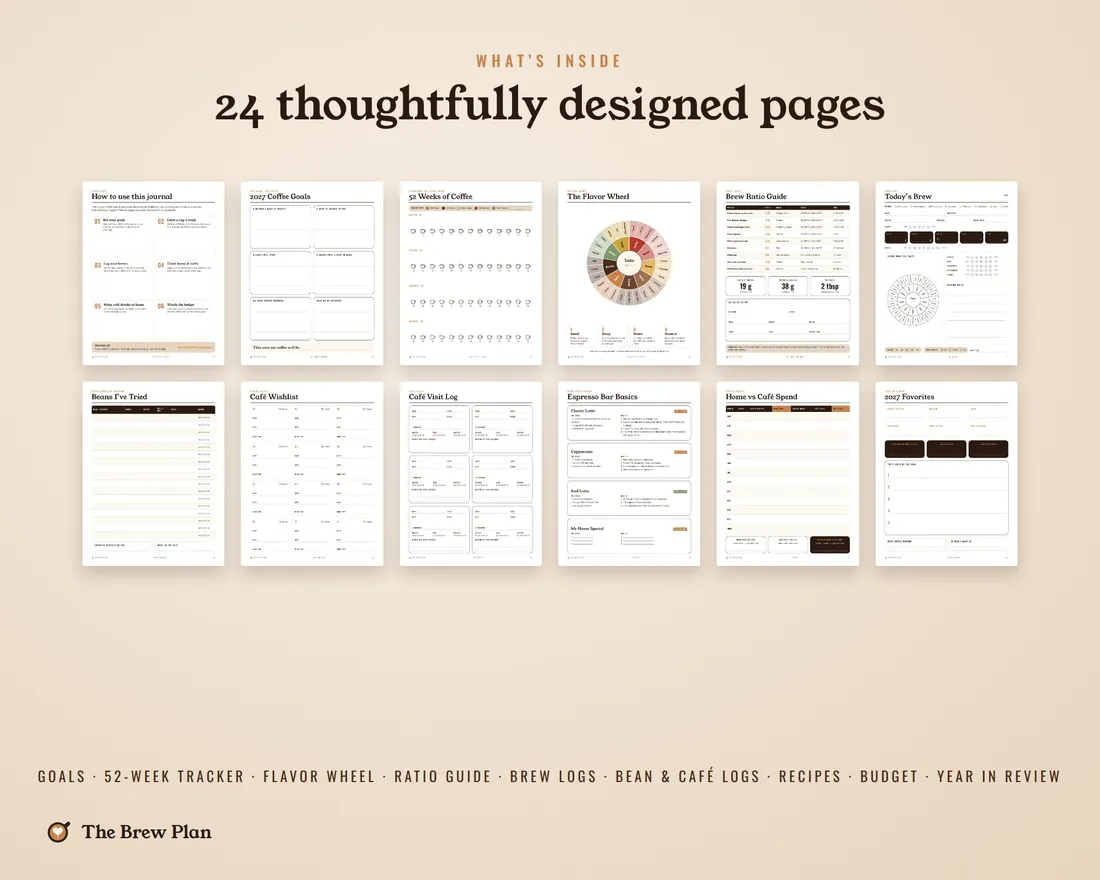
Write down the brews you love
Brew logs with dose, ratio, grind and a flavor wheel in our 2027 Coffee Journal.
See inside →Keep brewing
Cold brew calculator · Home café savings calculator · Caffeine calculator · Espresso ratio calculator
All 6 tools →How to use the coffee ratio calculator
A coffee ratio is simply 1 part coffee to X parts water, by weight. At 1:16, every gram of coffee gets 16 grams of water. Because 1 ml of water weighs about 1 gram, you can read "grams of water" and "ml of water" as the same number, which is why a kitchen scale is the single best upgrade for home coffee.
- Pick your brew method. Each method starts at a sensible default ratio and a strength range that suits it.
- Choose how you measure. Know how many cups you want? Use cups. Filling a specific carafe? Use water. Only have 20 g of beans left? Use coffee.
- Slide to your strength. Left is stronger (less water per gram), right is milder. Adjust by half a step at a time: small changes are easy to taste.
Good starting ratios by brew method
| Method | Start at | Range | Grind |
|---|---|---|---|
| Pour-over | 1:16 | 1:14 to 1:18 | Medium-fine |
| Drip machine | 1:16 | 1:15 to 1:18 | Medium |
| French press | 1:15 | 1:12 to 1:17 | Coarse |
| Piston press | 1:14 | 1:11 to 1:17 | Fine-medium |
| Moka pot | about 1:8 | 1:7 to 1:10 | Fine-medium |
| Cold brew | 1:8 | 1:4 (concentrate) to 1:12 | Coarse |
The Specialty Coffee Association's Golden Cup guideline works out to roughly 55 grams of coffee per litre of water, or about 1:18. In practice most home brewers land between 1:15 and 1:17, which is why 1:16 is such a popular middle ground (it even has its own ratio club mug).
Quick ratio cheat sheet
No time to play with the slider? Here are the most common amounts, rounded to a tenth of a gram:
| Water | 1:15 (bolder) | 1:16 (classic) | 1:17 (lighter) |
|---|---|---|---|
| 250 ml (one small cup) | 16.7 g | 15.6 g | 14.7 g |
| 355 ml (12 oz mug) | 23.7 g | 22.2 g | 20.9 g |
| 500 ml (two small cups) | 33.3 g | 31.3 g | 29.4 g |
| 1 litre (a full carafe) | 66.7 g | 62.5 g | 58.8 g |
Brewing for a crowd in a big drip machine? Batch brews often taste best a touch stronger (around 1:15 to 1:16), because larger beds of coffee extract a little differently and the coffee may sit on a warmer for a while.
Why weigh coffee instead of using scoops?
A tablespoon of beans can weigh anywhere from about 4 to 7 grams depending on the roast, the bean size and whether you level it. Dark roasts are less dense than light roasts, so the same scoop holds less coffee. A $15 kitchen scale that reads in 1-gram steps removes that guesswork, and it makes a great recipe repeatable. No scale yet? The calculator shows level tablespoons of whole beans (about 5 g each) as a rough guide.
How big is a "cup" of coffee?
This trips up a lot of people. Many drip machines count a "cup" as 5 or 6 fluid ounces, not the 8 ounces in a measuring cup, and your favorite mug probably holds 10 to 12 ounces. Pick the cup size that matches what you actually drink and the numbers will follow.
Fixing the taste: your ratio is only half the story
If a cup tastes off, change one thing at a time:
- Sour, thin or salty: usually under-extracted. Grind a little finer, brew a little longer or use hotter water.
- Bitter, harsh or drying: usually over-extracted. Grind a little coarser or shorten the brew.
- Tastes good but too strong: move the slider right (more water). You can also add hot water to the cup.
- Tastes good but watery: move the slider left (more coffee).
Water matters too. Most guides recommend water just off the boil, around 90 to 96°C (195 to 205°F), and filtered water if your tap water tastes strongly of chlorine or minerals. Grind right before brewing if you can, and see our grind size chart for what "medium-fine" actually looks like.
Why the cup holds less than the water you pour
Coffee grounds soak up water and hold on to it. A common rule of thumb is that grounds retain about twice their weight in water, so 30 g of coffee keeps roughly 60 ml. That's why the calculator shows a smaller "in the cup" number. If you need exactly 500 ml of finished coffee, brew with a little extra water.
Related guides
Questions people ask
What is the golden ratio for coffee?
The most common "golden ratio" is about 1:15 to 1:18 coffee to water by weight. The Specialty Coffee Association's Golden Cup guideline is about 55 g of coffee per litre of water (roughly 1:18), and many home brewers prefer 1:16 as a balanced starting point.
How many grams of coffee for one cup?
For an 8 oz (237 ml) cup at 1:16 you need about 15 g of coffee. For a 12 oz mug (355 ml) at 1:16, use about 22 g.
How many tablespoons of coffee per cup?
Roughly 2 to 3 level tablespoons of ground coffee for an 8 oz cup, since a level tablespoon holds about 5 g. Weighing is more accurate because density varies by roast and grind.
What ratio should I use for French press?
Start at 1:15 (for example 30 g coffee to 450 g water) with a coarse grind and a 4-minute steep. Go to 1:12 or 1:13 if you like it bold.
Is the ratio by weight or volume?
By weight. Because 1 ml of water weighs about 1 g, grams of water and millilitres are interchangeable, but coffee should be weighed in grams.
Results are estimates for general information. Everything runs in your browser; nothing you type is stored or sent.